Cryptocurrency has moved far beyond early adopters and tech circles. As digital assets become part of everyday finance, more employees are asking a practical question: could part of their paycheck come in crypto?
To better understand this shift, Oobit surveyed 1,004 full-time employees about their experiences with and appetite for crypto payroll. We found growing curiosity, real-world adoption, and clear barriers that still need to be addressed.
Crypto compensation is no longer a niche idea. Interest is widespread, though it varies across demographics and experience levels.
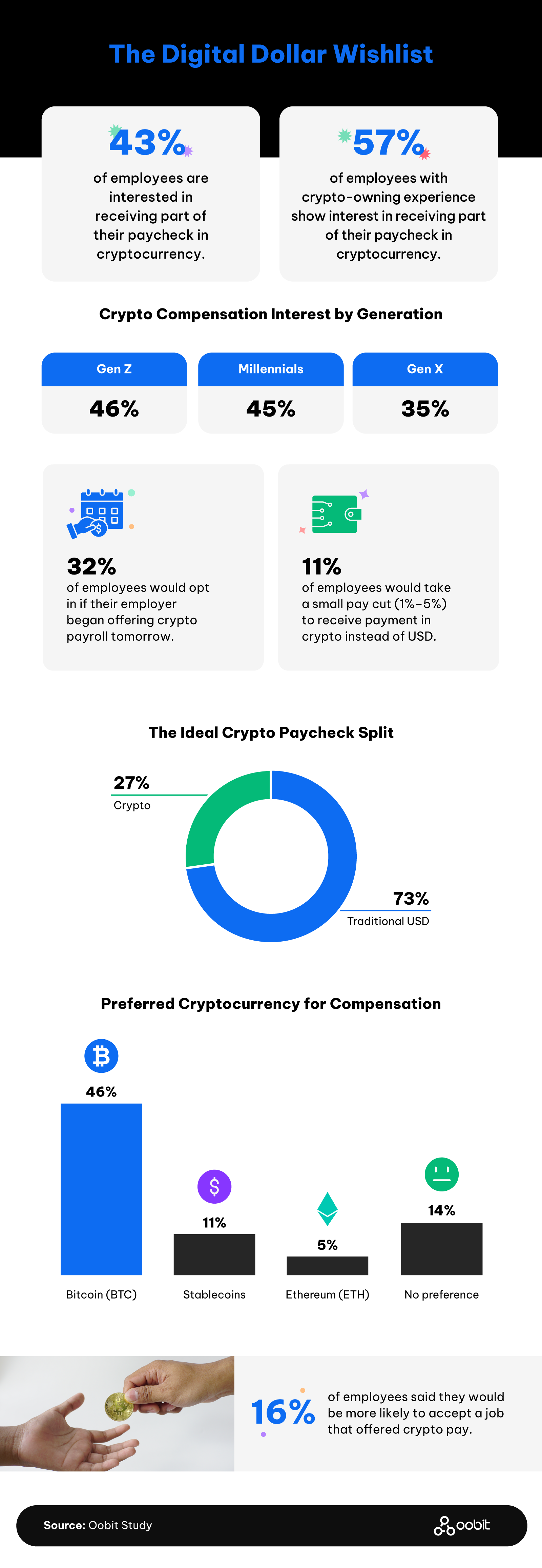
Overall, more than 2 in 5 employees had at least some interest in receiving compensation in cryptocurrency. Furthermore, 57% those with crypto-owning experience show interest. Active crypto traders or investors were more than three times as likely to show interest compared to those who never owned or currently don't own crypto (86% vs. 27%).
Interest skews younger, but spans generations. Gen Z led at 46%, followed closely by millennials (45%). Gen X came in at 35%. When asked which currencies they preferred, Bitcoin (46%), stablecoins (11%), and Ethereum (5%) ranked highest, with 14% having no preference.
If their employer offered crypto payroll starting tomorrow, 32% said they would likely participate. Among employees open to crypto pay, the average ideal allocation was 27%, with the remaining 73% in traditional USD.
Crypto compensation may also influence recruiting. More than 1 in 10 employees (16%) said it would make them more likely to accept a job offer. And 11% said they would accept a 1%–5% pay cut to receive part of their compensation in crypto. Among active traders, that number jumps to 26%.
While many workers are still considering crypto paychecks, a meaningful share has already experienced it.
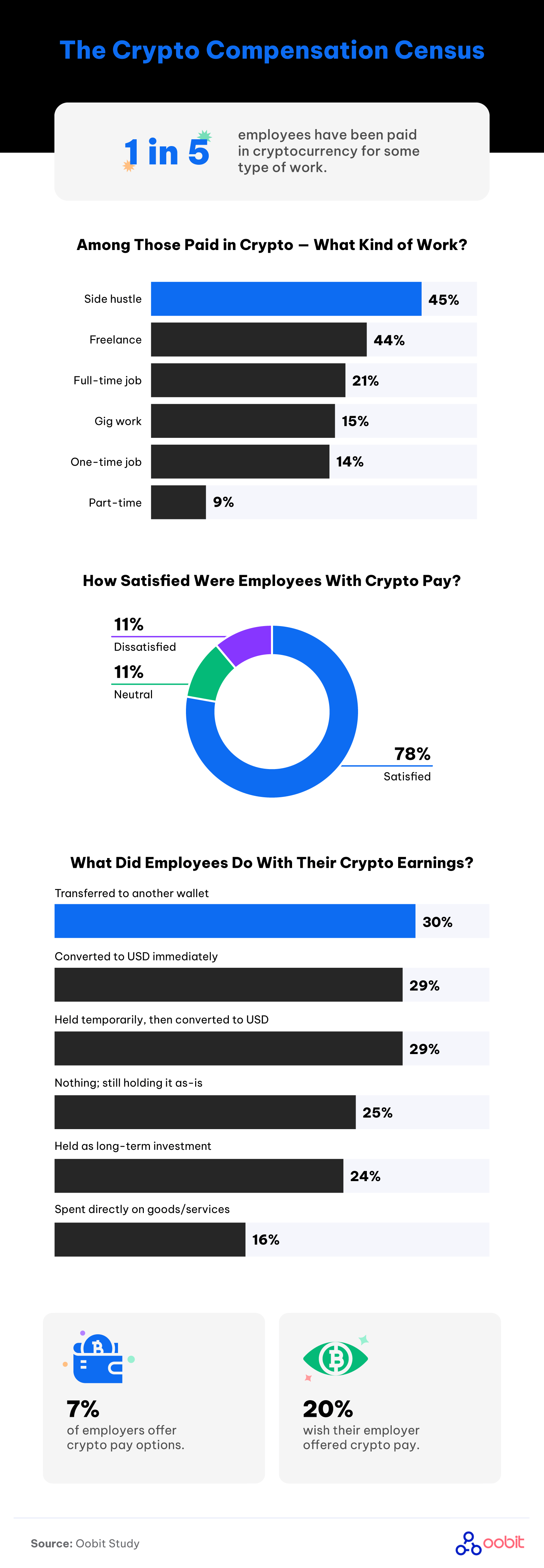
One in five employees reported being paid in cryptocurrency for some type of work, and adoption again skewed younger:
Satisfaction was high. Among those who had been paid in crypto, 78% said they were satisfied.
Most crypto payments happened outside traditional payroll systems. Side hustles accounted for 45%, followed by freelance work (44%). Full-time roles represented 21%, while gig work (15%), one-time jobs (14%), and part-time roles (9%) followed.
Employees handled those payments in different ways:
Despite this activity, employer adoption remains limited. Only 7% of employees said their employer offers crypto payroll options. Meanwhile, 20% said they wish their employer did.
For all the interest and adoption, concerns about crypto's stability are still significant.
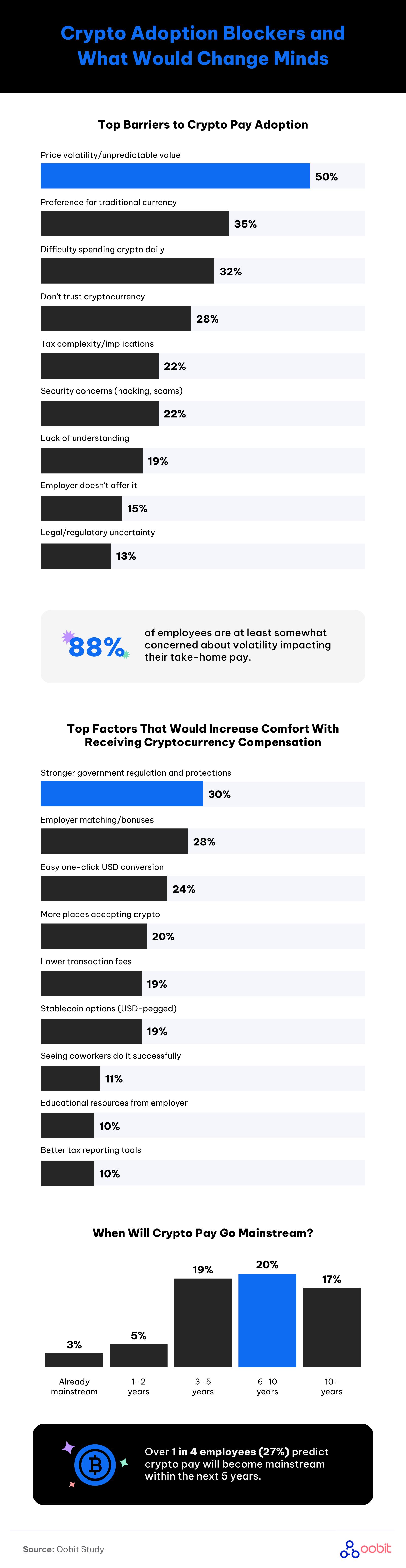
Half of employees (50%) cited price volatility as their top barrier to accepting crypto pay. Other concerns included:
In total, 88% said they are at least somewhat concerned about volatility. When asked what would make them more comfortable, employees pointed to clearer regulation (30%), employer matching or bonuses (28%), and simple one-click USD conversion options (24%).
As for the future, 27% believe crypto payroll could become mainstream within five years. Others expect a longer timeline: 6–10 years (20%) and 10 or more years (17%).
Crypto payroll is no longer hypothetical. Interest is widespread, and real-world usage is already happening through freelance and side work. At the same time, employees want simplicity, flexibility, and stability. Tools that allow instant conversion, access to stablecoins, and clear reporting could make a difference.
For employers, crypto pay won't replace traditional payroll overnight. But for certain segments of the workforce, it may offer a meaningful incentive.
For this study, we surveyed 1,004 full-time employees about their experiences with and attitudes toward cryptocurrency compensation; 4% of respondents reported as baby boomers, 21% reported as Gen X, 55% reported as millennials, and 20% reported as Gen Z.
Oobit makes it easy to pay with crypto in everyday life. Through our app, users can connect their own wallets and tap to pay in-store, online, or on the go wherever major cards are accepted. Users can also use the send crypto to bank feature to transfer internationally with ease. Oobit helps turn crypto into a simple, practical way to spend.
This content is provided for noncommercial use only. If you reference these findings, please include proper attribution and a link to Oobit.