Back

Bernard Fisher
Back
Bernard Fisher
June 25, 2026
•
5
min read

Table of contents
Growth: From Curiosity to Habit
What Dubai's Crypto Spenders Are Actually Buying
When Do People Spend Crypto in Dubai?
✓
Dubai has spent years positioning itself as the world's most crypto-friendly city. The policy agenda is well-documented: VARA, the world's first dedicated virtual asset regulator, launched in 2022. The Dubai Multi Commodities Centre has issued hundreds of crypto licenses. Binance, Bybit, OKX, and dozens of other major exchanges have made the UAE their regional headquarters.
But policy is one thing. Actual day-to-day spending with crypto is another. Here is what happens when you look at the real transaction data.
Oobit users in the UAE have completed thousands of crypto payments at real-world merchants. The average transaction sits comfortably in everyday spending territory, not the realm of one-off luxury purchases.
That average is meaningful. It is not the number you would see if crypto in Dubai were only being used for prestige purchases or real estate deposits. It is the number of a population that is paying for groceries, ordering dinner, and catching a ride with cryptocurrency.
The trajectory of crypto spending in the UAE has not been linear. It has been an explosion.
Transaction volume in Q1 2026 was more than 30x higher than all of 2024 combined. By mid-2026, monthly transaction counts were running roughly 32x above the monthly average seen through most of 2024. The active user base grew more than 6x between Q4 2025 and May 2026 alone.
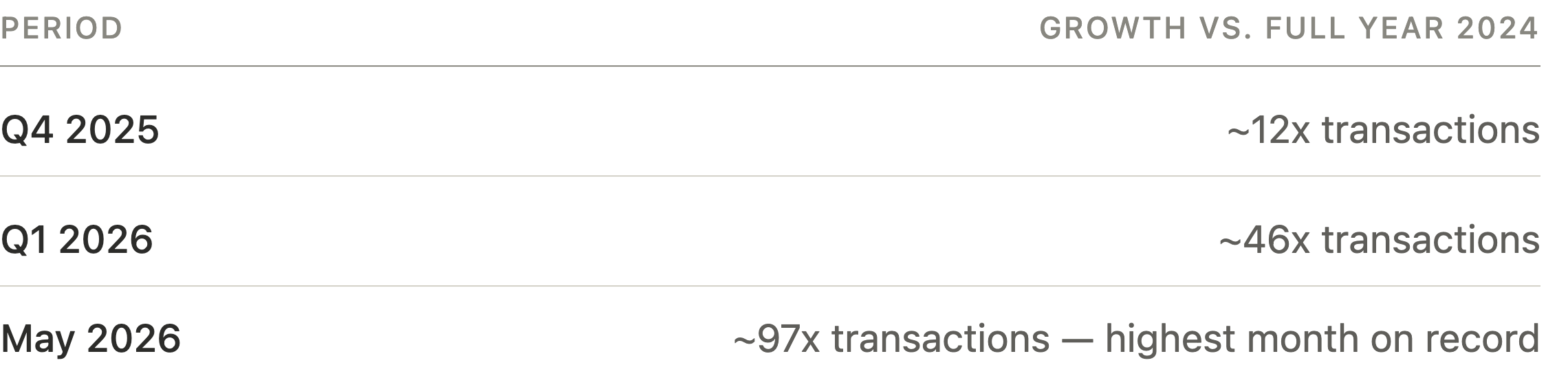
The user base has also grown in depth, not just breadth. In late 2024, a small number of heavy users were driving the majority of volume. By mid-2026, the distribution across users has broadened significantly, with the active spender base growing more than 500% year over year.
This is where the data gets genuinely interesting. The most common uses of crypto in Dubai are not luxury goods, speculation, or international transfers. They are the same things people everywhere spend money on.
Food and delivery dominate. Grocery and supermarket spending is the single largest category by transaction count, followed closely by restaurants and food delivery. Together, food-related merchants account for roughly 40% of all transactions in the UAE. Talabat alone is the highest-frequency merchant on the platform. Deliveroo, Carrefour, and Noon Minutes all feature prominently.
The everyday utility categories are well represented. Dubai Electricity and Water Authority (DEWA), government services via the Smart Dubai portal, and telecom providers collectively account for around 15% of total transaction volume, reflecting genuine integration of crypto into recurring household expenses.
And then there is a distinctly Dubai layer. Emirates and flydubai together represent a meaningful share of the highest-value transactions. Dubai Duty Free, Atlantis The Palm, Louis Vuitton, Berluti, and OUNASS all appear in the top merchant list. Real estate developer Damac Homes has received crypto payments averaging among the highest of any merchant on the platform.
RAK Track and Al Ain Raceway, both motorsport venues, are notable outliers, a reminder that the UAE's appetite for experiential spending extends to track days paid for in digital assets.
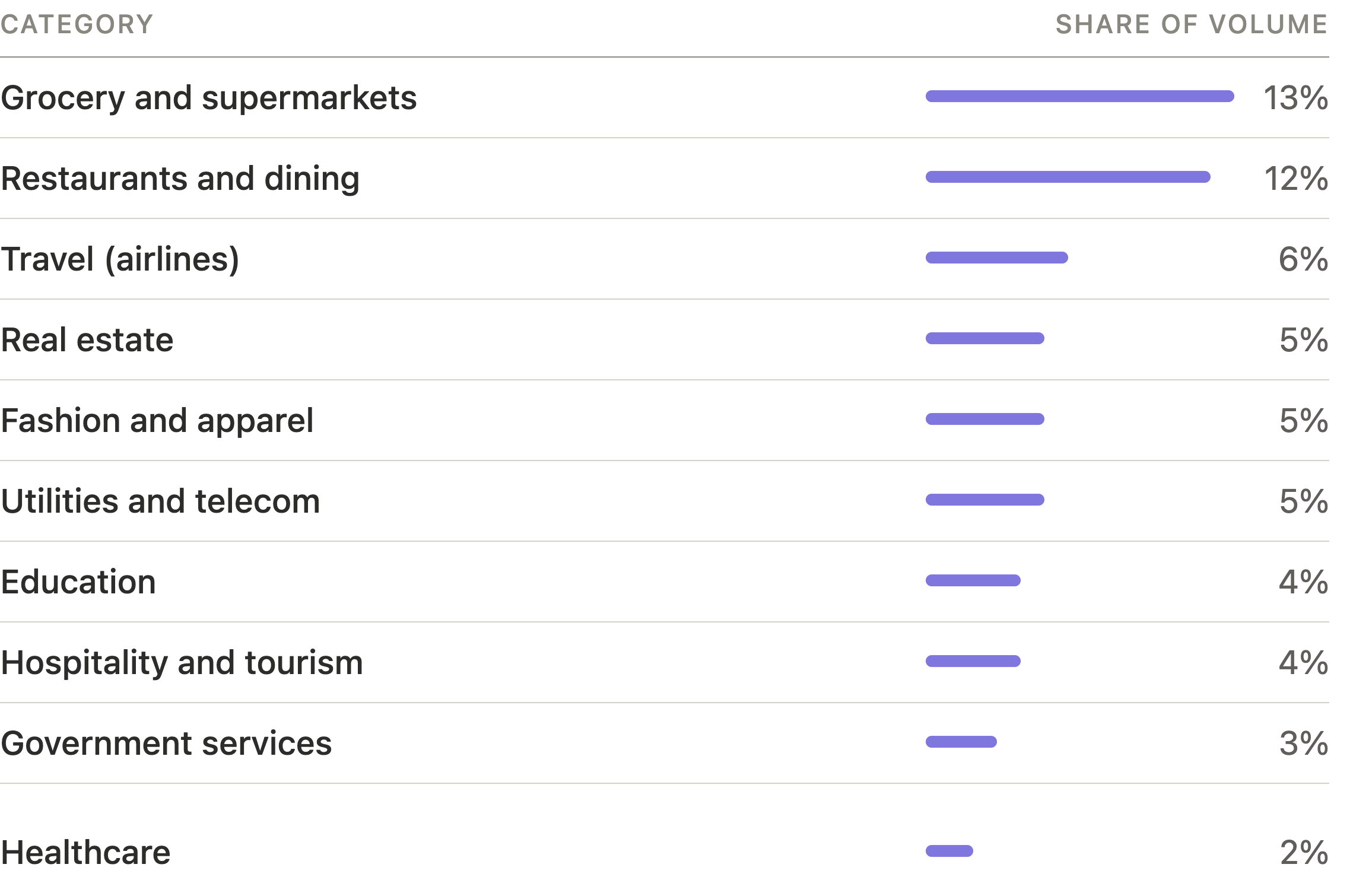
The healthcare and education entries are worth pausing on. School fee payments and medical clinic visits make up a small but meaningful share of crypto spending in the UAE, suggesting that crypto is being used for significant, planned expenditure, not just impulse spending.
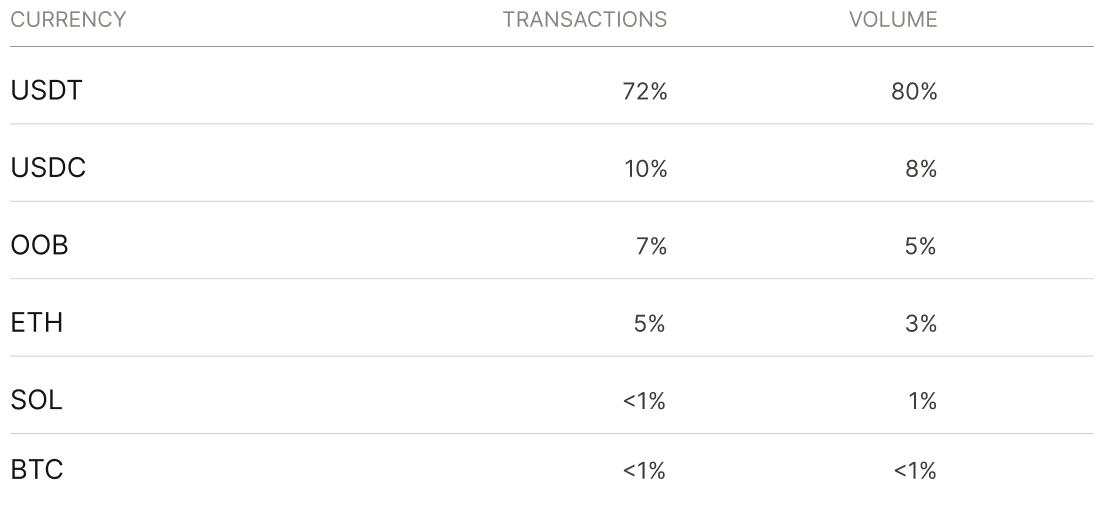
USDT accounts for the vast majority of crypto spending in Dubai, representing 72% of all transactions and 80% of total volume. This is not surprising. The UAE's currency (the dirham) is pegged to the dollar, and Dubai's expatriate population, which makes up around 90% of residents, thinks in dollar terms. A stablecoin pegged to the dollar removes volatility from the equation and makes crypto spending functionally indistinguishable from spending USD.
USDC is the second most-used currency at around 8% of volume. ETH, SOL, and BTC follow. Bitcoin, despite its dominant brand recognition, accounts for less than 1% of volume. In practice, people are not spending their Bitcoin in Dubai. They are spending stablecoins.
For those who do, you can still pay with Bitcoin directly at the same Visa terminals.
Since USDT drives most of the spending above, here is how it works in practice. You do not need to convert to dirhams first or find a merchant that accepts crypto. The merchant receives a standard Visa payment in AED, and USDT is deducted from your wallet at checkout.
Need cash instead? You can withdraw USDT as dirhams at contactless ATMs with Oobit ATM withdrawals. For more on how stablecoin spending works, see our guide to paying with USDT.
Dubai dominates, accounting for approximately 77% of all UAE crypto spending on the platform. Abu Dhabi comes in second at around 8%. Ajman, a smaller emirate, also registers meaningful volume at roughly 1%, with the remainder spread across other emirates and unattributed transactions.
This is consistent with Dubai's international character. The emirate's population is younger, more internationally connected, and more likely to be early adopters of financial technology than the UAE average.
Sunday sees the highest average transaction value, running roughly 16% above the weekly average. This reflects the UAE's working week, which runs Sunday through Thursday, making Sunday the equivalent of Monday in most of the world. Friday has the highest raw transaction count but a lower average spend, suggesting more small-ticket activity like food delivery on the weekend.
The data from Oobit's UAE users tells a story that does not match the common narrative about crypto spending. Dubai's crypto economy is not primarily about speculation, prestige, or regulatory arbitrage. It is about paying for the same things everyone pays for, with a more convenient form of money.
The explosive growth curve, running at nearly 100x the pace of two years ago, coincides with wider crypto card infrastructure becoming available and trusted in the region. As more merchants accept contactless payments and users become comfortable with stablecoin wallets, the barrier to spending crypto at a Dubai supermarket has effectively disappeared.
The city that has worked hardest to legislate crypto into mainstream use is seeing it show up exactly where you would expect: at the checkout counter.
Oobit is a crypto card and payments platform that lets users spend Bitcoin, USDT, and other digital assets at any Visa-accepting merchant worldwide. Oobit operates across 81 countries, including the UAE.
Data in this article reflects completed Oobit user transactions in the UAE as of June 2026.
Latest articles
_2026-10-05_06-22-13.png)
How to Buy an Apple or iTunes Gift Card With Bitcoin in 2026
October 4, 2026
•
4
min read
_2026-09-28_13-19-05.png)
Grok Bot AI Payments: A Guide to Grok Payments With Crypto
September 28, 2026
•
5
min read
_2026-09-28_13-00-35.png)
Meta Muse AI Agent Payments: How to Let Muse Shop With Your Crypto
September 28, 2026
•
5
min read
Open your treasury, hold dollars, and start paying the world.
Abre tu tesorería, guarda dólares y empieza a pagarle al mundo.
Abra seu tesouro, guarde dólares e comece a pagar o mundo.
If you're excited by the future of money, we'd love to hear from you.
Scan the QR code to download the app

The People's Money.
Pay with Oobit
Crypto CardLocal QR PaymentsATM WithdrawalsCrypto Cashback Ai PaymentsOobit DePay
Pay with BitcoinPay with OOBPay with USDTPay with EthereumPay with SolanaStablecoin
Oobit For Business
BlogGlobal USDPay International ContractorsCorporate CardStablecoin Expense Management
Oobit Technologies 2026. © All rights reserved.
Oobit provides technology that enables users to spend digital assets through existing payment networks. Services are subject to regional availability and regulatory requirements. Oobit operates through multiple entities globally. Certain features may be provided by licensed partners depending on your location.
US Cryptocurrency services are provided in partnership with Bakkt Financial Solutions I, LLC. Bakkt is registered with FinCEN as a Money Services Business (MSB) and holds state money transmitter licenses.