Download oobit app to pay with crypto everywhere.

Scan the QR code to download the app







_2026-07-23_10-43-00%201(1).avif)
A stablecoin crosses a border in under a second for a fraction of a cent. It is spent at a supermarket checkout through a card terminal. Then the user needs to pay a plumber, a market vendor, a landlord who does not take cards, and the whole stack stops being useful. Turning that balance into crypto to cash is the step that breaks it.
The industry has treated that moment as a transitional inconvenience. Cash is legacy; it will fade. This piece argues the opposite: cash-out, not spending, is the bottleneck in crypto payments. The markets where stablecoin adoption is growing fastest are the markets where cash is still the settlement layer of daily life, and a balance that cannot reliably become local notes is not money there. The industry's first answer - a standalone fleet of crypto ATMs - failed because it tried to rebuild a network that already exists. The answer that works is the one that solved retail spending: reuse the network, do not rebuild it. Roughly 2.9M ordinary ATMs already stand where people live, and Oobit's July launch is the first product to treat them as crypto's cash rails.
The data below is why.
The World Bank's Global Findex 2025 put account ownership at 79% of adults worldwide. The other side of that number is 1.3B adults with no account at all, more than half of them concentrated in eight economies: Bangladesh, China, Egypt, India, Indonesia, Mexico, Nigeria and Pakistan.
Put that list next to a map of stablecoin adoption and the overlap is hard to ignore. These are not markets where crypto is a speculative hobby. They are markets where a dollar-pegged token is a defensive instrument.
Mobile money has done real work here - 40% of adults in Sub-Saharan Africa and 37% in Latin America now hold an account. But it is not cash independence. It is a digital layer that still terminates, most of the time, at an agent or a machine handing over physical notes. The cash-out step did not disappear. It moved.
That is the environment stablecoins are entering. A payment stack that stops at the card terminal covers the supermarket and leaves out the plumber, the vendor and the landlord - which, in these economies, is most of the month's spending.
The industry's designated solution to the cash problem was purpose-built hardware, standing alone, converting coins into cash. It is now shrinking: from roughly 39,000 machines at the end of 2025 to 28,322 by June 30, 2026, a 27.7% contraction in six months, with the United States accounting for 96% of the removals.
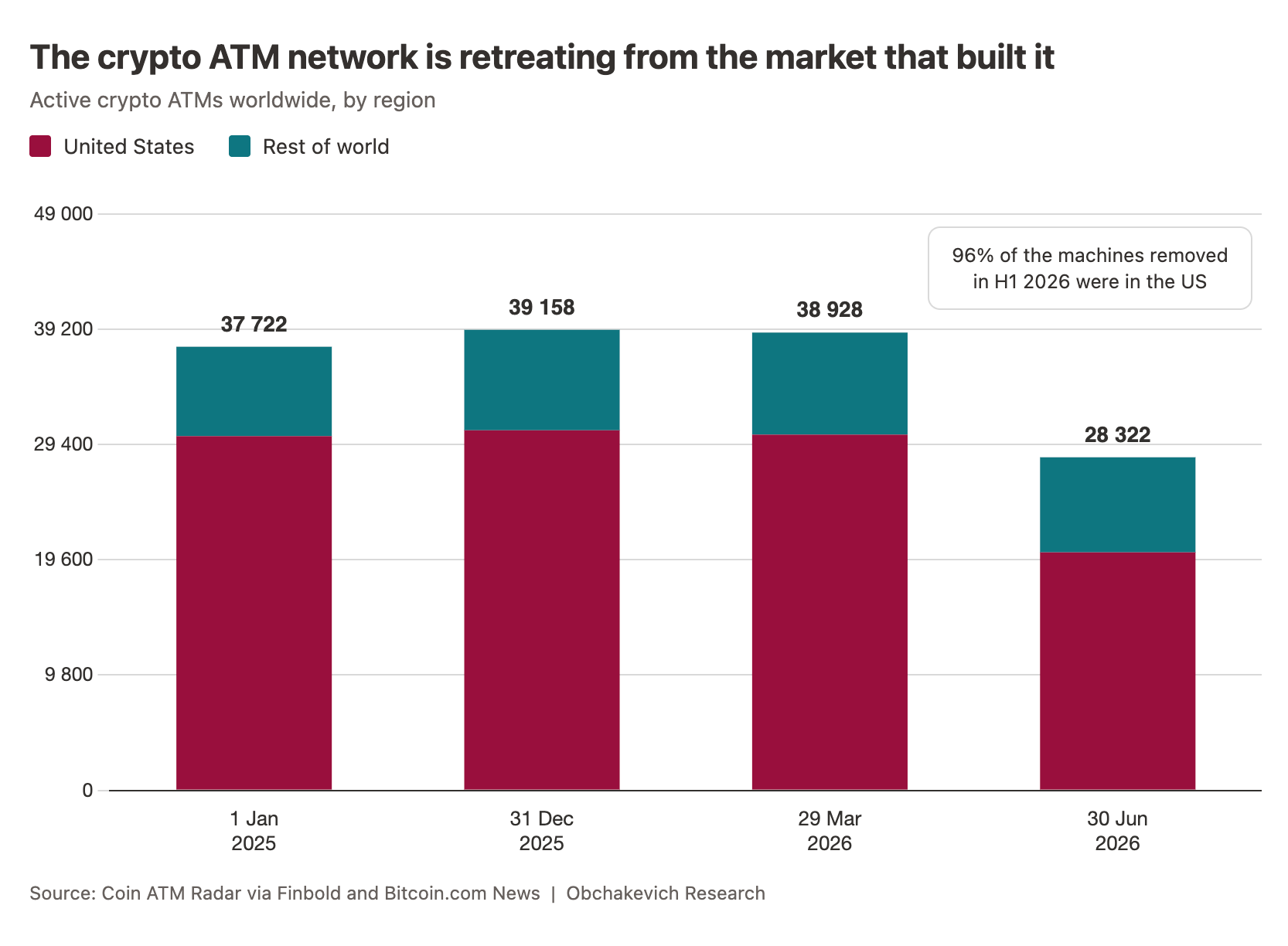
The revealing number is the distribution, not the decline. Earlier in 2026 the US, Canada and Europe together held about 92% of the network. At its peak, the infrastructure built to solve crypto's cash problem sat almost entirely in countries with dense branch networks, near-universal account ownership and working card acceptance - in other words, the countries that needed it least.
The reason is economics rather than ideology. A standalone machine has to earn its own rent, its own cash logistics, its own compliance program. That works with wide spreads in a high-income market. It does not work where the average withdrawal is small and the compliance burden is identical. The crypto ATM never reached the users in the Findex list because it could not afford to.
Nobody solved retail crypto payments by persuading millions of merchants to install new terminals. It was solved by routing crypto balances through the acceptance layer that already existed.
Cash access has the same shape. Roughly 2.9M ATMs operate worldwide - about a hundred times the peak crypto ATM count, and distributed where people actually live. They already handle cash logistics, already meet local regulatory requirements, and a growing share of them read NFC. If a crypto balance can present itself to an ordinary ATM as a card, the last mile stops being an infrastructure problem and becomes a routing problem.
This is the answer the crypto ATM was reaching for and could not deliver, and Oobit shipped it in late July. KYC-verified users withdraw cash by tapping a phone at an NFC-enabled ATM, drawing from their balance through the virtual card on the device. No physical card, no linked bank account, no exchange withdrawal first. Up to $250 per transaction, three withdrawals per card per day, subject to a compatible ATM being nearby. Crypto to cash happens in seconds at the terminal, with no linked bank account required. Nothing about it is exotic. It is everyday cash access, sized for everyday needs, running on machines that were already there.
Oobit's own framing matches the argument of this piece. Announcing the launch, Amram Adar, Oobit's co-founder and CEO, described the gap the product was built to close:
Stablecoins move globally and spend at the point of sale, but the moment someone needs physical cash, the experience breaks.
That sentence is the whole problem. Global settlement and point-of-sale spending were solved by reusing card rails. Cash is now being solved the same way.
Crypto reads a withdrawal as value leaving the system. In payments, the opposite holds. People hold balances they believe they can exit. A worker paid in stablecoins who cannot reliably turn part of that into local notes is not a stablecoin user; they are someone with a problem, and they will convert at the first opportunity, at whatever informal rate is going that week.
Reliable cash-out is what makes a stablecoin balance something a person is willing to keep. Take it away and the balance is a liability to be cleared; provide it and it becomes savings, payroll, working capital.
Spending is where crypto payments get their headlines. Cash is where they get their users.





_2026-10-06_13-48-20.png)
_2026-10-05_06-22-13.png)
_2026-09-28_13-19-05.png)
%202.svg)