Download oobit app to pay with crypto everywhere.

Scan the QR code to download the app





_2026-07-27_07-48-36%201.avif)
Brazil set two records in 2025, and at first glance they contradict each other.
The first is Pix. Nearly 80 billion transactions in a year, over R$35 trillion in volume, 148 million individual users - 86% of the country's adult population. A system the central bank launched in 2020 pushed cash out of everyday purchases and made cards optional in five years.
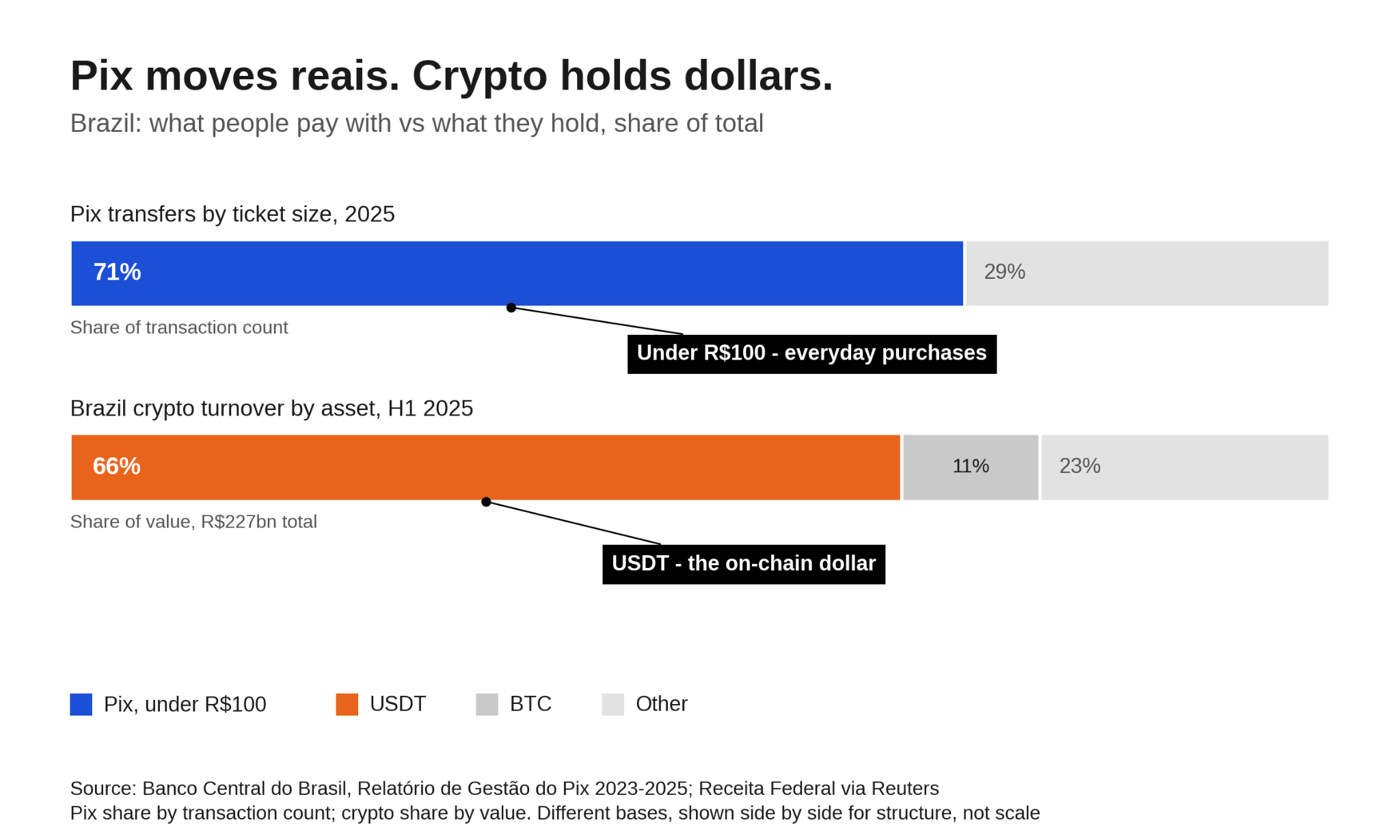
The second is stablecoins. In the first half of 2025, crypto turnover in the country reached R$227 billion, and two-thirds of that was Tether. Bitcoin accounted for 11%. In other words, in the country with the best instant payment system in the world, people are buying tokenised dollars at scale.
There is no contradiction. Pix is a rail, not an asset. 71% of all Pix transfers are under R$100: coffee, taxis, groceries, everything that used to be cash. Pix moves reais perfectly. It says nothing about what those reais sit in between purchases. USDT answers a different question - not "how to pay" but "what to hold". Two different needs, two different systems, and neither displaces the other.
The most convincing proof is the state's own behaviour. Since February 2026, stablecoin operations in Brazil are regulated as foreign exchange. The finance ministry has floated extending the IOF transaction tax to stablecoin purchases; five industry associations representing over 850 companies replied that this contradicts the 2022 Virtual Assets Law, and put the market at 25 million participants and $6-8 billion in monthly flows, 90% of them stablecoins. And from October 1st, Resolution 561 bars regulated eFX providers from settling cross-border payments in stablecoins.
Look at what the regulator is actually dealing with. Not blockchain, not bitcoin - the on-chain dollar as a competitor to its own FX channel. That is how you treat something that has already become infrastructure, not an experiment.
For the user, the model is simple: hold in USDT, spend through Pix. The problem is that an exchange usually sits between those two steps. Sell the stablecoin, wait for reais to land in the account, then pay - three actions, three moments where the rate, the fee and the delay work against the person. That gap is what Oobit closes.
In the app, money is held in USDT and the user pays in reais: scan a Pix QR code at a store or on an invoice, and the recipient sees an ordinary Pix transfer. Oobit handles the conversion, not the person. The same principle applies to the Oobit card, which lets users tap to pay anywhere Visa is accepted and withdraw cash at contactless ATMs, for the cases where Pix isn't accepted. And in the other direction: a transfer from abroad arrives in stablecoins and reaches the recipient in Brazil through Pix. The user doesn't need to buy reais in advance and keep them in an account - the dollar stays a dollar until the moment it is needed. That is the answer to what a stablecoin is for in a country where payments are already free: it is not needed instead of Pix, it is needed before it.
Pix beat cards and cash. It didn't beat the dollar, because it never tried - it has a different job. The question for 2026 is not whether stablecoins survive next to the world's best payment rail, but how much the state is willing to pay to keep the two apart.








_2026-10-06_13-48-20.png)
_2026-10-05_06-22-13.png)
_2026-09-28_13-19-05.png)
%202.svg)